Thursday, April 14, 2022

Week 3: Robotics + Art

 This week our lectures and associated materials covered topics of industrialization in terms of the mechanization and widespread distribution of art. The birth of mechanization began with the invention of the printing press and metal movable type, credited to Gutenberg but originally created by the Chinese, that increased page production from around 40 pages per day to upwards of 3,500. This stark expansion in the reproduction of written works cultivated a new way of information sharing, as it now allowed for rapid dispersion of knowledge, religion, and scientific discoveries. 

Original Printing Press, Courtesy of HISTORY.com

It was the innovation set forth by the printing press and the use of mechanization that transformed the way in which many handmade items were made, including the arts. Walter Benjamin examines the role of mechanization in the art realm and what replicated or copied art signifies about the piece itself. Benjamin argues that “the uniqueness of a work of art is inseparable from its being embedded in the fabric of tradition” and that by changing the way by which art is produced we are inherently changing the aura, the ritual, and the meaning for which the piece was constructed. This discussion also comes at a time of emerging art fields such as photography and eventually film, in which the basis of these mediums’ rely on prints or replicas, permanently changing what it means to be authentic while also reconsidering values behind traditional art making.
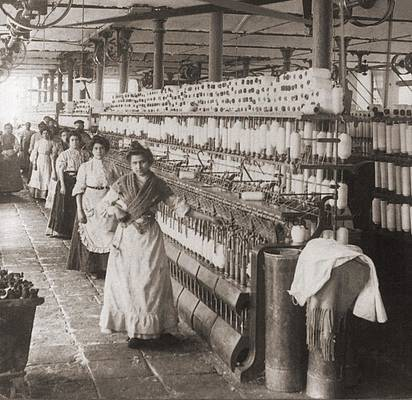

Mechanization of textile production, Courtesy of Fine Art America

The evolution of art creation as well as the way in which we appreciate art could not have occurred without industrialization, mechanization, and eventually widespread technology. I argue that this transformed way of making and viewing art with the aid of technology and mechanization is beneficial as it allows for worldwide accessibility to view the piece. I also am aware of how this new technology and use of digital or duplicated work can result in a loss of traditional authenticity or sense of uniqueness. Overall, the inevitability of this changing field in light of mechanization and industrialization allows for more information, artwork, and techniques to be shared and enjoyed amongst a worldwide audience, globally expanding our artistic network and furthering the development of new art forms.

Video of how art can be replicated today using 3D technology, Courtesy of FastCompany.com


Sources:

Benjamin, Walter. "The Work of Art in the Age of Mechanical Reproduction." 1936.

Davis, Douglas. “The Work of Art in the Age of Digital Reproduction (An Evolving Thesis: 1991-1995).” Leonardo, vol. 28, no. 5, 1995, pp. 381–86. JSTOR, https://doi.org/10.2307/1576221.

Diaz, Jesus. “We’re Entering a New Era of Cheap and Perfect Knock-off Art.” Fast Company, 29 Nov. 2018, https://www.fastcompany.com/90272935/were-entering-a-wild-new-era-of-cheap-and-perfect-knock-off-art.

“Mechanization Art.” Fine Art America, https://fineartamerica.com/art/mechanization. Accessed 14 Apr. 2022.

Mirenfred. Dirk the Homeless Robot/Www.Electric-Circus.Eu. 2008. YouTube, https://www.youtube.com/watch?v=5HfmKXfp394.

Roemer, Robin. Chapter 08 - Mechanization of the Printing Press. p. 11.

Roos, Dave. “7 Ways the Printing Press Changed the World.” HISTORY, https://www.history.com/news/printing-press-renaissance. Accessed 14 Apr. 2022.

Vesna, Victoria. "Lectures Part 1." DESMA 9, 11 April 2022, UCLA, Bruinwalk, Unit 3.


Tuesday, April 12, 2022

Event 1: BioArt

 The event I attended this week explored the applications and possibilities of utilizing technology to enhance our biological experience, while also highlighting some fascinating equipment already being engineered to see just how far we can intertwine math, technology, and biology. 

Depiction of how the technological advances work to correlate the senses, courtesy of BioArt event by Aisen Caro Chacin

    This week's speaker, Aisen Car Chacin, does work that wonderfully highlights the intersection between technology, art, and science by pushing the boundaries on just how far we can take and enhance our biological senses. Chacin discusses her many projects throughout her career, all focussed around the central idea of utilizing technology as a prosthetic to intensify the ability to perceive or transverse through life. Her interventions both intensify and provide new ability to patients that would otherwise not have such a sensation. In doing so, Chacin is reimagining the future body and the functions we perceive as “normal”. 


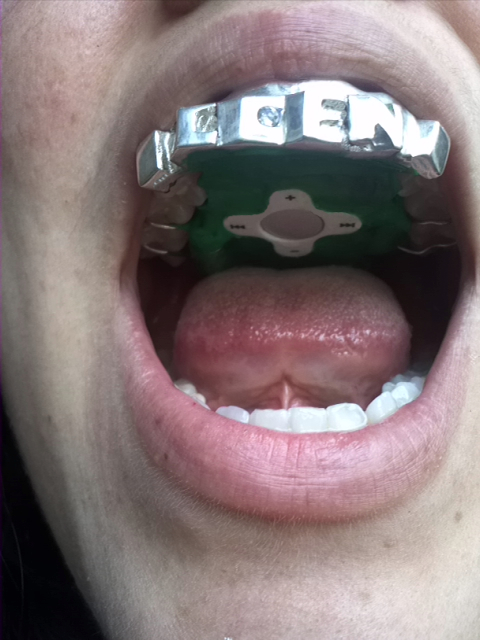
An example of the type of inventions made is shown above. A grill that can be used to listen to music through your teeth, courtesy of Aisencarochacin.com

Chacin also focuses on the artistic and approachability of her inventions, noting that the technology not only should be useful and empower more diverse realities, but they should also be approachable to the consumer audience. Here is where the artistic aspect comes into play and the necessity of building ideas and projects to accommodate the larger goal, even in an extremely technical job.

Image of Stelarc with ear transplant on forearm to reimagine body engineering, courtesy of Radio National

This event is definitely something that I would recommend to fellow classmates, as it was an exceptional example of the merging between three seemingly disparate fields into a very fascinating and nuanced way of reimagining the human body and its relationship with technology.


Image of Aisen Caro Checin, courtesy of UCLA Sci Center + Lab


Sources:

Aisen Caro Chacin | UCLA Art | Sci Center + Lab. https://artsci.ucla.edu/node/1345. Accessed 8 Apr. 2022.

Aisen Caro Chacin. http://www.aisencaro.com/play-a-grill.html. Accessed 12 Apr. 2022.

Aisen Caro Chacin - 2 Artworks, Bio & Shows on Artsy. https://www.artsy.net/artist/aisen-caro-chacin. Accessed 12 Apr. 2022.

BioArt + Assistive Device Art: Transformation of Ability and Perception, the Plasticity of the Mind, and Human Expansion - Sanctuary For Independent Media. https://www.mediasanctuary.org/event/bioart-assistive-device-art-transformation-of-ability-and-perception-the-plasticity-of-the-mind-and-human-expansion/. Accessed 12 Apr. 2022.

“STELARC: EAR ON ARM.” Radio National, 21 Mar. 2012, https://www.abc.net.au/radionational/programs/archived/bodysphere/stelarc-ear-on-arm/3903988.

SVA Bio Art Lab – Art & Science. SVA BFA Fine Arts – New York City. https://bioart.sva.edu/. Accessed 12 Apr. 2022.


“Champagne for the Blind: Paul Bach-y-Rita, Neuroscience’s Forgotten Genius.” MIT Comparative Media Studies/Writing, 1 Sept. 2013, https://cmsw.mit.edu/paul-bach-y-rita-neurosciences-forgotten-genius/.


Tuuri, Kai, and Oskari Koskela. “Understanding Human–Technology Relations Within Technologization and Appification of Musicality.” Frontiers in Psychology, vol. 11, 2020. Frontiers, https://www.frontiersin.org/article/10.3389/fpsyg.2020.00416.


Proof of attendance


Friday, April 8, 2022

Week 2: Math + Art

I found this week's material to be quite eye-opening as we explored just how closely related science and art truly are.


Architectural Geometric Beadwork, courtesy of beadmobile.wordpress.com

Until the Henderson reading I have previously not considered how the fourth dimension became realized and the time and consideration it took to land upon an agreed concept and framework in which to define it. The amount of collaboration across artists of many fields to agree and modernize the language, beliefs, and future of art as they knew it took extreme courage. The fourth dimension, as Henderson says, challenges the many long-standing ‘truths’ to which artists functioned, and rethinks their reality as entering new territory.

Visualizing the Fourth Dimension, courtesy of Duke Research Blog

Flatland, by Edwin A. Abbott, explores the ideas surrounding perspective through the storytelling of geometric shapes living in a two-dimensional world. The limitations set forth by each own’s perspective have an immense impact on their ability to understand and think deeper about the third dimension, resulting in fear and discouragement to explore the unknown. This analogy relates to Henderson’s piece and the overwhelming sense of fear many people experience with the oncoming of change, or something new that shifts their perspective. Taken together, I’ve learned that it requires a combination of math and science to create accurate, modern, and relevant art, while also requiring art to showcase the fascinating new perspectives resulting from high math and science. A great example of this is the high math craft used to create exceptionally intricate and realistic models through artwork.

Toxic Reef and Mathematics Blackboard, courtesy of crochetcoralreef.org

In the resources for this week I was drawn to the crochet coral reef, a project aimed to emulate and bring awareness to the intricate and time-consuming work performed in nature that is currently being threatened by climate change. Here, the artists imitate the natural hyperbolic shapes created by living organisms as a way to incorporate the most accurate depiction of true coral, while also challenging the mathematical perspective of hyperbolic shapes. This particular art claims that in making mathematical structures you are doing mathematics, just as is done in nature, and further highlights the necessity of math to produce art.

Coral Forest, courtesy of crochetcoralreef.org

The juxtaposition of art, math, and science are quite intertwined. Math itself is an art form, and science and the natural world display organic examples of mathematics and artistic displays all around us. The observer requires a perspective willing to accept the merging of three disciplines as one.


Sources:

Abbott, Edwin A. Flatland: A Romance of Many Dimensions. New York: Dover Publications, 1884.

ART+COM Studios. https://artcom.de/en/. Accessed 8 Apr. 2022.

Center, Art|Sci. DESMA 9 Week 2 Featuring Kate McKinnon. 2021. Vimeo, https://vimeo.com/533410774.

“CONTEMPORARY GEOMETRIC BEADWORK.” CONTEMPORARY GEOMETRIC BEADWORK, https://beadmobile.wordpress.com/. Accessed 8 Apr. 2022.

Crochet Coral Reef. https://crochetcoralreef.org/about/theproject/. Accessed 7 Apr. 2022.

Frantz, Marc. Lesson 3: Vanishing Points and Looking at Art. p. 11.

Henderson, Linda Dalrymple. “The Fourth Dimension and Non-Euclidean Geometry in Modern Art: Conclusion.” Leonardo, vol. 17, no. 3, 1984, pp. 205–10. JSTOR, https://doi.org/10.2307/1575193.

“Visualizing the Fourth Dimension.” Research Blog, 26 Apr. 2017, https://researchblog.duke.edu/2017/04/26/visualizing-the-fourth-dimension/.


Thursday, March 31, 2022

Week 1: Two Cultures


As someone who previously resonated well with the idea of being a "left brained" scholar, one that is better suited for logic, mathematics, and science, I found this weeks resources to be quite fascinating and made me question the way our society has historically chosen to separate these disciplines so harshly. 

Depiction of left & right brain hemispheres, courtesy of Harvard Health Publishing

Growing up as a child I enjoyed trying a range of activities, anything form theater camp and art class to math after-school daycare and engineering programs. Throughout the trail and error I found myself aligning deeply with tasks involving logic, reason, and a single right answer, while becoming increasingly frustrated with areas of my extracurriculars that encouraged expressive forms of creativity and outward imagination. Although I was learning where I felt a sense of belonging and where I was tending to shy away from, I was never concerned about turning down artistic opportunities because I was often assured I was a "left-brained" person and functioned better with a certain subset of tasks. As I reflect back, and after reviewing the materials from this week, I am left to wonder how my perception of the arts could have been different if I was pushed outside of my comfort zone and encouraged into more expressive activities.

Separation of Science and the Arts, and what Lies Between, Courtesy of Steemit @g0nr0gue

From the historical background on this separation through the lecture videos as well as an artist's viewpoint in professor Vesna's article on the third culture, I can begin to understand why this conversation originated and the basis for C. P. Snows argument. The two disciplines are seemingly opposite while still holding strange similarities and being of grave importance to society. I can understand how the Universities, especially form an economic and workforce perspective, have encouraged this divide into what we observe today. The danger is, however, the two cultures in light of the modern day and technology are becoming more intertwined than ever before, and we must find ways to bridge the communities that benefits the user experience and information sharing. The explosion of technology has hugely influenced the merging between artists and scientist into a mutual space where communication is key. The idea of a third culture is presented to bridge the two cultures, however I believe the best solution will result from a deeper understanding and communication between the respective sides towards a unified common goal.

"Is it Possible to be a Scientist and an Artist?" courtesy of PBS Learning Media


Sources:

Kelly, Kevin. "The Third Culture." The Third Culture. N.p., n.d. Web. Feb. 1998

“Science & Art: A Perfect Relationship.” Steemit, 30 July 2017, https://steemit.com/science/@g0nr0gue/science-and-art-a-perfect-relationship.

Shmerling, Robert H., MD. “Right Brain/Left Brain, Right?” Harvard Health, 25 Aug. 2017, https://www.health.harvard.edu/blog/right-brainleft-brain-right-2017082512222.

Snow, C. P. The Two Cultures ; and the Scientific Revolution. University Press, 1959.

Vesna, Victoria. “Toward a Third Culture: Being in Between.” Leonardo, vol. 34, no. 2, 2001, pp. 121–25.

Viskontas, Indre. “Is It Possible to Be a Scientist and an Artist?” PBS LearningMedia, https://www.pbslearningmedia.org/resource/da2f81a8-65e7-4ce8-a277-9d26815d00b9/is-it-possible-to-be-a-scientist-and-an-artist/. Accessed 31 Mar. 2022.

Wilson, Stephen. “Myths and Confusions in Thinking about Art/Science/Technology.” 2000.


Event 3: Mark Cohen & Nueroscience

  The event I attended this week was led by Dr. Mark Cohen, an inventor, scientist, and entrepreneur with extensive experience and training ...